Diploma project · In development


Short challenges. A clearer view of your progress.
A mobile app concept connecting cognitive tests, daily practice and personal performance in one experience.
Development Roadmap
From defining the product to refining the experience. A live view of the work, not a release schedule.
Completed
Research & Definition
Product challenge, proto-persona and competitive analysis.
Completed
Product Structure & UX Flows
Information architecture and the core training paths.
Completed
Visual Identity & Design System
Identity, category colors, icons and reusable components.
In progress
UI Design
Refining core screens and supporting interface states.
In progress
Interactive Prototype
Connecting and refining the main interaction paths.
Upcoming
Planned Screens & States
Onboarding, settings and the daily training summary, as outlined in the product documentation.
The Idea
Not just another score. A reason to come back.
Three categories. One daily practice. Relay brings Memory, Reaction and Focus into a connected experience, with feedback after each challenge and a view of personal progress over time.
The concept separates showing up from performing well: daily activity supports consistency, while the proposed rating reflects test results rather than accumulated XP.

Memory
Recognize patterns, remember sequences and reproduce them.

Reaction
Respond to short challenges through timing and quick decisions.

Focus
Stay attentive and concentrate on a specific task.
Behind the Decisions
Four chapters connect the documented product challenge to the structure and daily flow of the current concept.
The Product Challenge
Product context
Short cognitive tests become one connected daily experience.
Relay is a mobile app concept for short cognitive tests across Memory, Reaction and Focus. It brings daily challenges, result tracking and a competitive rating into one consistent experience.
Defined challenge
An isolated score says little about progress.
A single test captures a moment. Without a connection to prior attempts, the current performance and the next goal are difficult to understand.
Design objectiveCreate a short, motivating daily experience that connects the tests, makes results understandable and tracks personal progress over time.
Competitive Analysis
Five products reveal different models for tests, training and motivation.
Four direct competitors and Duolingo as an indirect reference were compared through public information and official product documentation.
Direct competitors
Human Benchmark
Standalone measurement of specific cognitive abilities.
Lumosity
A personalized cognitive program with an initial measurement.
Elevate
Development of language, mathematics and memory skills.
Peak
Short games with adaptive training formats.
Indirect reference
Duolingo
A learning product used as a reference for habit-building mechanics.
Comparison matrix
How progress and competition work
The products use different measures for performance, progress and competition. Relay describes a proposed model, not a launched or validated system.
| Feature / Comparison |  Human Benchmark |  Lumosity |  Elevate |  Duolingo | Relay (Planned) |
|---|---|---|---|---|---|
| Core experience | Standalone cognitive tests | Personalized daily brain training | Skill-based daily workouts | Language lessons | Cognitive tests + daily routine |
| Primary progress metric | Test scores and percentiles | Game, cognitive-area and overall LPI | EPQ | Duolingo Score, course progress and XP | Recent-performance rating |
| Competitive comparison | Per-test percentiles | Age-group LPI percentiles | Age-group rankings + XP leagues | XP-based weekly leagues | Rating-based leaderboard |
| How repeated practice affects progress | Individual test results | Recent scores can update LPI | First 7 wins per game count daily | Lessons and practice can earn XP | Up to 3 rated attempts + 1 daily update |
| Progress structure | Individual tests | Game, cognitive area and overall LPI | Game and category performance | Course progress, Duolingo Score and leagues | Test, category and overall rating |
| Practice without affecting competitive rating | No separate mode documented | Zen Mode does not affect LPI | Replays after the daily max do not affect EPQ or XP | No equivalent separate mode documented | Separate free practice |
Competitor mechanics reflect official product documentation reviewed in October 2026. LPI, EPQ, XP, Duolingo Score and the proposed Relay Rating are different systems, not equivalent measures.
Why Relay takes a different approach
Relay is designed around a simple principle: playing more should not automatically mean ranking higher.
Its proposed rating system prioritizes recent test performance across Memory, Reaction and Focus. Limited rated attempts help reduce repetitive score farming, while free practice remains separate from competitive progress.
The goal is to make rankings reflect how users perform, not simply how often they play.
Design interpretations
What the comparison suggests for Relay
Quick access to tests
A test should be easy to find and start.
Results in context
Result history helps explain personal progress.
Structured daily activity
A clear start and finish make the daily task understandable.
Separate consistency and performance
Showing up and performing well require different metrics.
This is a desk review, not user testing. The opportunities below are design interpretations that still need validation.
Information Architecture
Four main destinations organize four different intentions.
The sitemap separates today's activity, test discovery, competitive comparison and personal history. Designed, in-progress and planned UI work are marked independently.
In progress
Home
- Daily trainingIn progress
- Current progressIn progress
- Active testDesigned
- Test resultDesigned
- Completed trainingPlanned
In progress
Tests
- Memory, Reaction and FocusDesigned
- Test selectionIn progress
- Free practicePlanned
- Test resultDesigned
In progress
Ranking
- Overall ratingIn progress
- User positionIn progress
- RankingPlanned
- Leagues and ranksPlanned
In progress
Profile
- Personal statisticsIn progress
- Rating by categoryIn progress
- Result historyIn progress
- Personal recordsPlanned
- SettingsPlanned
Initial access also documents Welcome, Introduction, Register or Login and Enter app. The diagram focuses on the four main in-product destinations requested for this case study.
User Flows
The daily routine is a conditional loop, not a four-step sequence.
The documented flow returns to Home after every result, updates progress from 0/3 to 3/3 and repeats until the three categories are complete.
Home, test and result screens exist in the prototype. The full progress loop, completed training and daily summary states are planned. Instructions appear only when the selected test provides them.
Visual Identity & Design System
A focused identity system built around one recognizable signal, one type family and three functional category colors.
A signal that carries the product forward.
The Relay symbol abstracts the folds of the brain into a compact mark that subtly suggests the letter R. Paired with the custom wordmark, it creates a clear signature from the app icon to full product communication.
Typography
Onest
Onest keeps every level direct and readable.
The same geometric sans serif carries product headings, instructions, results and compact interface labels. Scale and weight create hierarchy without introducing another visual voice.
- Display64 / 74 - Medium
Daily training
- Heading32 / 40 - Medium
Your result
- Body16 / 24 - Regular
Complete one test from every category.
- Caption12 / 16 - Regular
PERSONAL BEST
Color system
Category color gives each task context.
Memory, Reaction and Focus keep distinct accents while the dark neutral foundation holds the experience together. Color identifies the category, not a different interface pattern.
Background#00000D
Primary text#FBFAFF
Secondary text#7E7C97
Inside Relay
A closer look at the product, from finding a challenge to understanding the result. Original Bulgarian UI from the current Figma prototype.
Find your challenge
Different skills. A familiar starting point.
The test library gives every category its own visual character while keeping selection and navigation consistent.
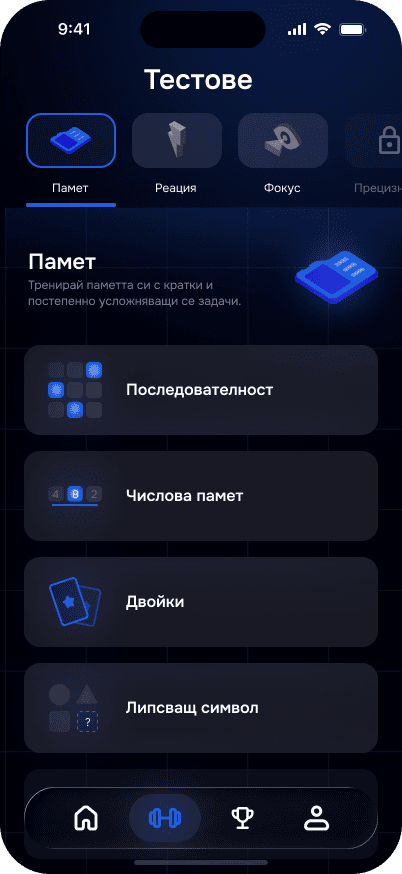
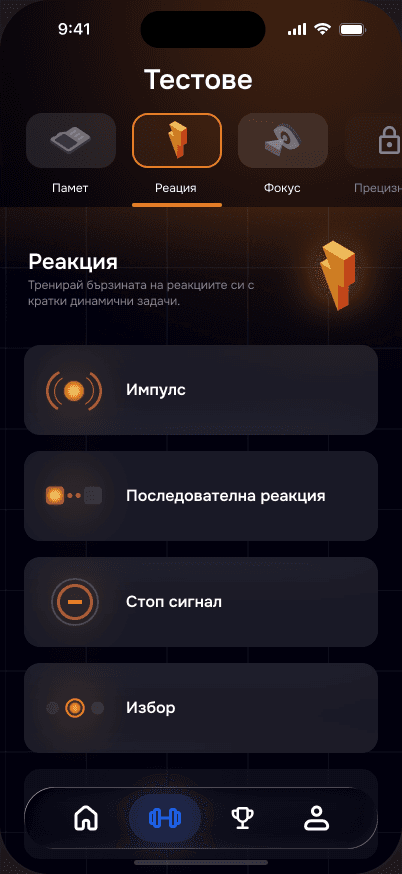
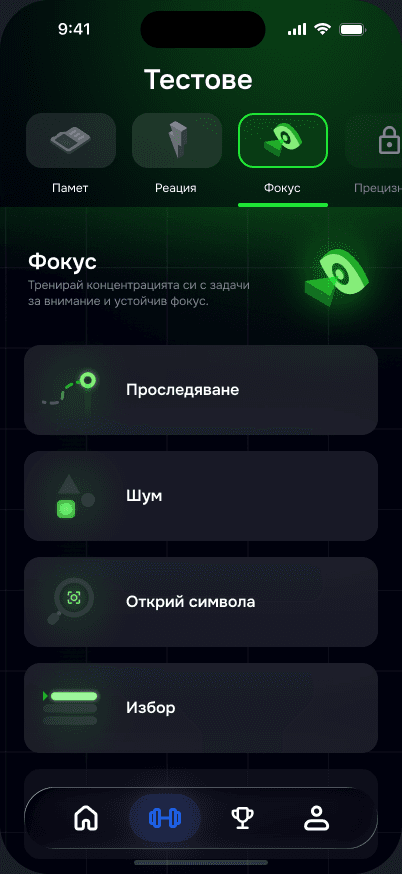
Test library / Memory, Reaction and Focus
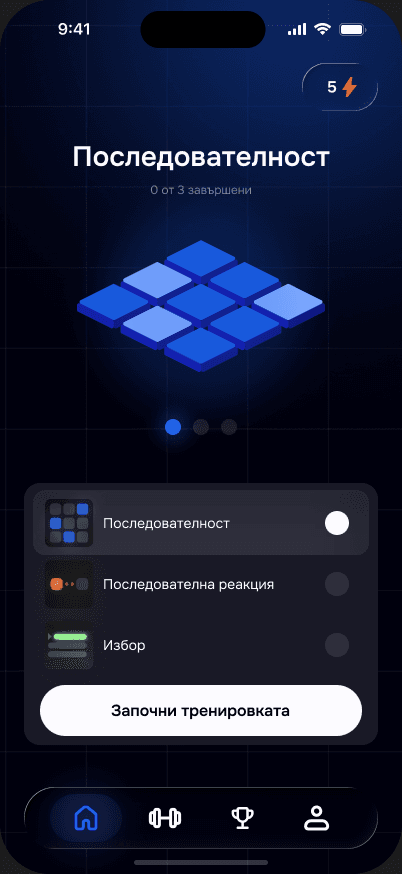
Build a daily rhythm
Three categories move through one connected routine.
The Home experience carries progress from Memory to Reaction and Focus without changing the underlying structure.
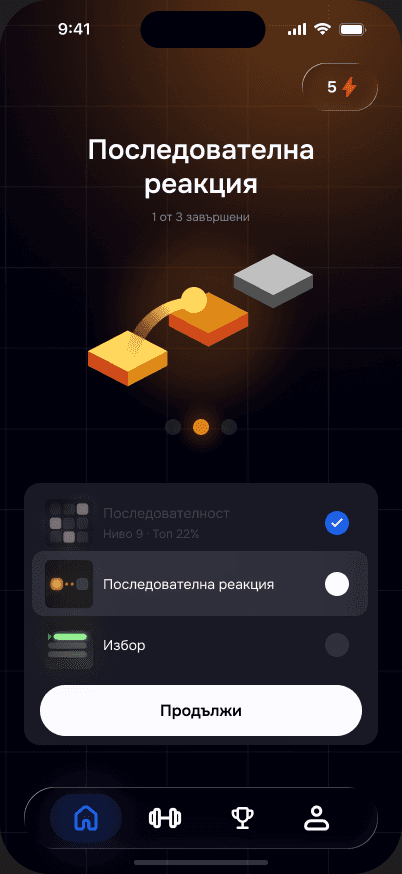
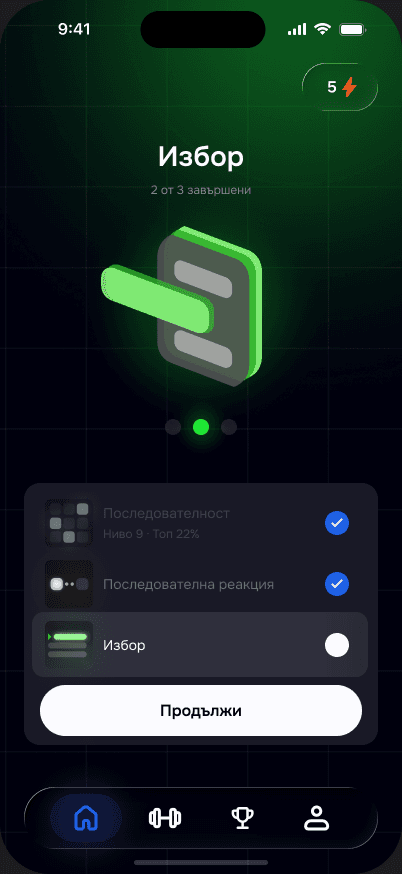
Daily training / Category progression
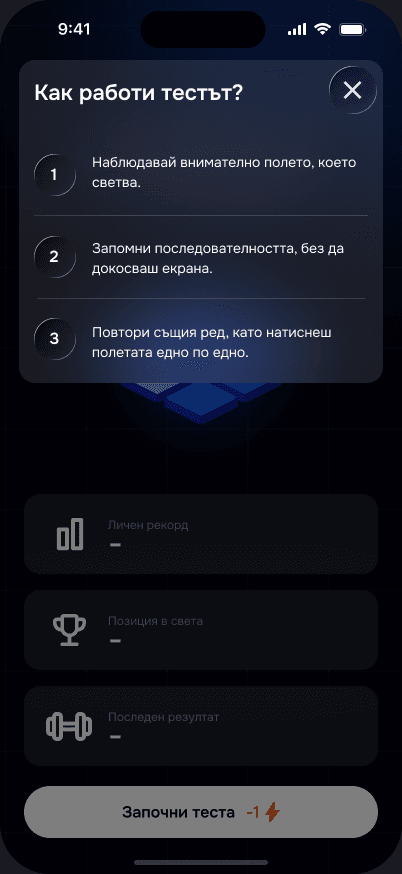
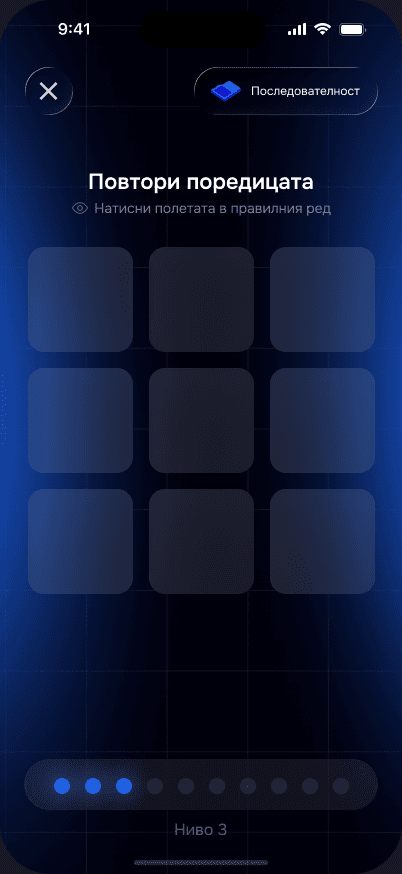
Sequence / Instructions and active test
Complete the challenge
Clear guidance leads into focused interaction.
Sequence explains the task before moving into the active test, keeping the interaction direct and easy to follow.
What's Next?
The foundations are here. The experience is still taking shape.
The next work is to connect and refine the prototype, resolve the remaining daily-training states and extend the supporting screens. This case study will evolve alongside those decisions.
An original diploma project in development. No launch date is set.